Custom AI Model Development
Unlock capabilities your current tools can’t deliver and do more with what you already have. Custom machine learning and predictive models — built on your data — give your organization a measurable edge in an increasingly AI-driven landscape.
What you receive:
A custom AI/ML model built on your data – turning static data into meaningful insights. You own the model we build.

Implementation:
Our team makes the implementation simple. We’ll work with you in phases, from problem framing to production deployment, with an option for ongoing support.

Is this the right fit?
If implementing AI has been on the back burner — due to unclear scope, scattered systems, or uncertain feasibility — this engagement gives you a working model designed specifically for you. It’s a natural follow-on to our Document Intelligence implementation.
Assay Quality Control
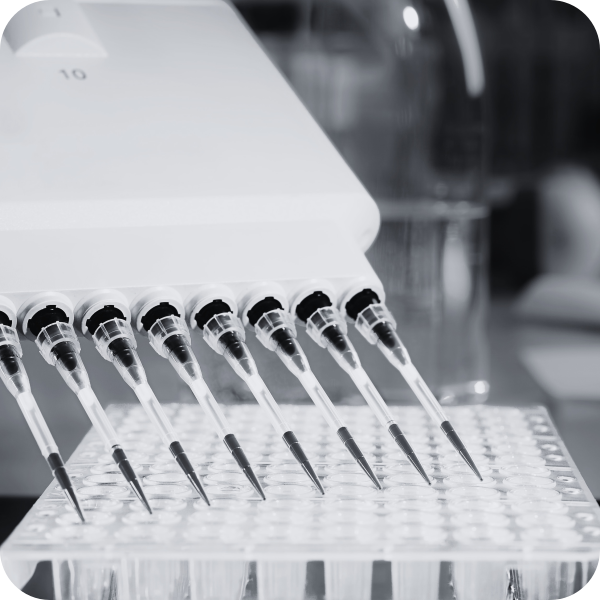
A custom model monitors assay plate data in real time, flagging wells, runs or batches that deviate from norms.
Time saved: Manual plate-by-plate review is eliminated. Your team see only the exceptions that need attention (with decision justification provided by the model).
Impact: Fewer repeat runs, less reagent waste, and faster batch release – without adding headcount to quality control review.
Compound Activity Prediction
A model learns the relationship between molecular structure and biological activity, predicting how untested compounds are likely to perform before they’re ever run.
Time Saved: Fewer compounds need to be physically screened. The most promising candidates move to the front of the queue.
Impact: Significant reduction in screening costs and a path to hit identification in early drug discovery.
Image-Based Analysis
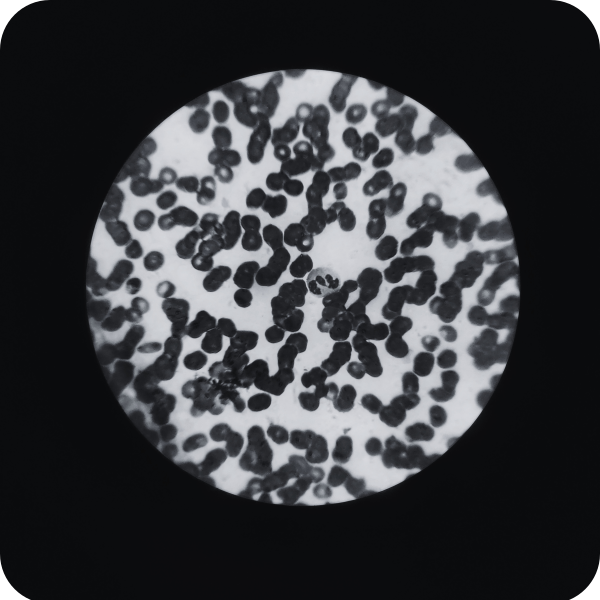
A model analyzes imaging data to classify cell phenotypes, count populations, detect morphological changes, or flag rare events across thousands of images.
Time Saved: Hours of manual image review are replaced by automated processing that doesn’t drift between analysts or across shifts.
Impact: Higher throughput from existing imaging infrastructure, with meaningfully reduced inter-analyst variability in scored outcomes.
Predictive Instrument Maintenance
A model analyzes instrument log data, performance trends, and usage patterns to predict when maintenance is needed.
Time Saved: Unplanned downtime is reduced. Your team stops scrambling to troubleshoot failed runs and starts scheduling maintenance on their own terms.
Impact: Extended instrument lifespan, fewer lost experimental days, and better visibility into maintenance windows before they become emergencies.
Assay Quality Control
A custom model monitors assay plate data in real time, flagging wells, runs or batches that deviate from norms.
Time saved: Manual plate-by-plate review is eliminated. Your team see only the exceptions that need attention (with decision justification provided by the model).
Impact: Fewer repeat runs, less reagent waste, and faster batch release – without adding headcount to quality control review.
Compound Activity Prediction
A model learns the relationship between molecular structure and biological activity, predicting how untested compounds are likely to perform before they’re ever run.
Time Saved: Fewer compounds need to be physically screened. The most promising candidates move to the front of the queue.
Impact: Significant reduction in screening costs and a path to hit identification in early drug discovery.
Image-Based Analysis
A model analyzes imaging data to classify cell phenotypes, count populations, detect morphological changes, or flag rare events across thousands of images.
Time Saved: Hours of manual image review are replaced by automated processing that doesn’t drift between analysts or across shifts.
Impact: Higher throughput from existing imaging infrastructure, with meaningfully reduced inter-analyst variability in scored outcomes.
Predictive Instrument Maintenance
A model analyzes instrument log data, performance trends, and usage patterns to predict when maintenance is needed.
Time Saved: Unplanned downtime is reduced. Your team stops scrambling to troubleshoot failed runs and starts scheduling maintenance on their own terms.
Impact: Extended instrument lifespan, fewer lost experimental days, and better visibility into maintenance windows before they become emergencies.
What’s the value of having a custom AI tool?
-
Your Data Stays Yours
Laboratory data represents years of proprietary research, regulated information, and competitive advantage. Internal AI systems keep that data inside your organization, with controlled access, clear audit trails, and full compliance with institutional and regulatory requirements. -
It’s Built Around the Way You Work
Off-the-shelf AI tools are designed for general use. A custom system can reflect your assay-specific logic, integrate directly with your LIMS, ELN, and instruments. And it adapts as your protocols evolve rather than forcing your team to adapt around it. -
Preservation of Scientific Knowledge
Every lab carries institutional knowledge that lives in the heads of experienced scientists. AI systems trained on internal data can encode that decision logic, reduce variability in how results are interpreted, and ensure that expertise doesn't walk out the door when people do. -
Scale Without Adding Headcount
With a well-designed production AI model, more can be achieved without a need to hire or overload your current team. Over time, the AI system can absorb the repetitive, high-volume work that currently consumes your team's time: flagging exceptions, reconciling data, generating reports, and iterating on experimental conditions. -
Built for Regulated Environments
In laboratory and clinical settings, a model is only as valuable as your ability to defend it to quality teams, auditors, and regulators. We build with that standard: explainable architectures, documented data provenance, and validation evidence structured for the inspections and submissions your organization faces
How We Build Useful Models From Your Data
-
Comprehensive data assessment. We evaluate what your data can and can't support before committing to an approach — and we'll tell you if it's not ready.
-
Model-ready data organizing. If your current data won’t support a model because it’s not uniformly labeled, scattered across systems, or you don’t have enough to properly train your model, we’ll do the work to get your data model ready.
-
Precise problem framing. Based on the problem you’d like to solve, we’ll narrow down the precise tasks your model performs.
-
Appropriate model selection. In regulated environments, a simple, well-documented model frequently outperforms more complex alternatives. In short, we won’t try to upsell you on a more sophisticated model. We’ll build the one that best serves your needs.
-
Production-ready architecture. Deployment constraints — security, regulation compliance, cloud architecture — are built in from day one.
-
Complete documentation. Training lineage, version history, and performance evidence are built into our process — essential for labs facing audits, submissions, or inspections.